In this article
Check whether a void is available, then document a refund against the original payment without losing the remaining balance.
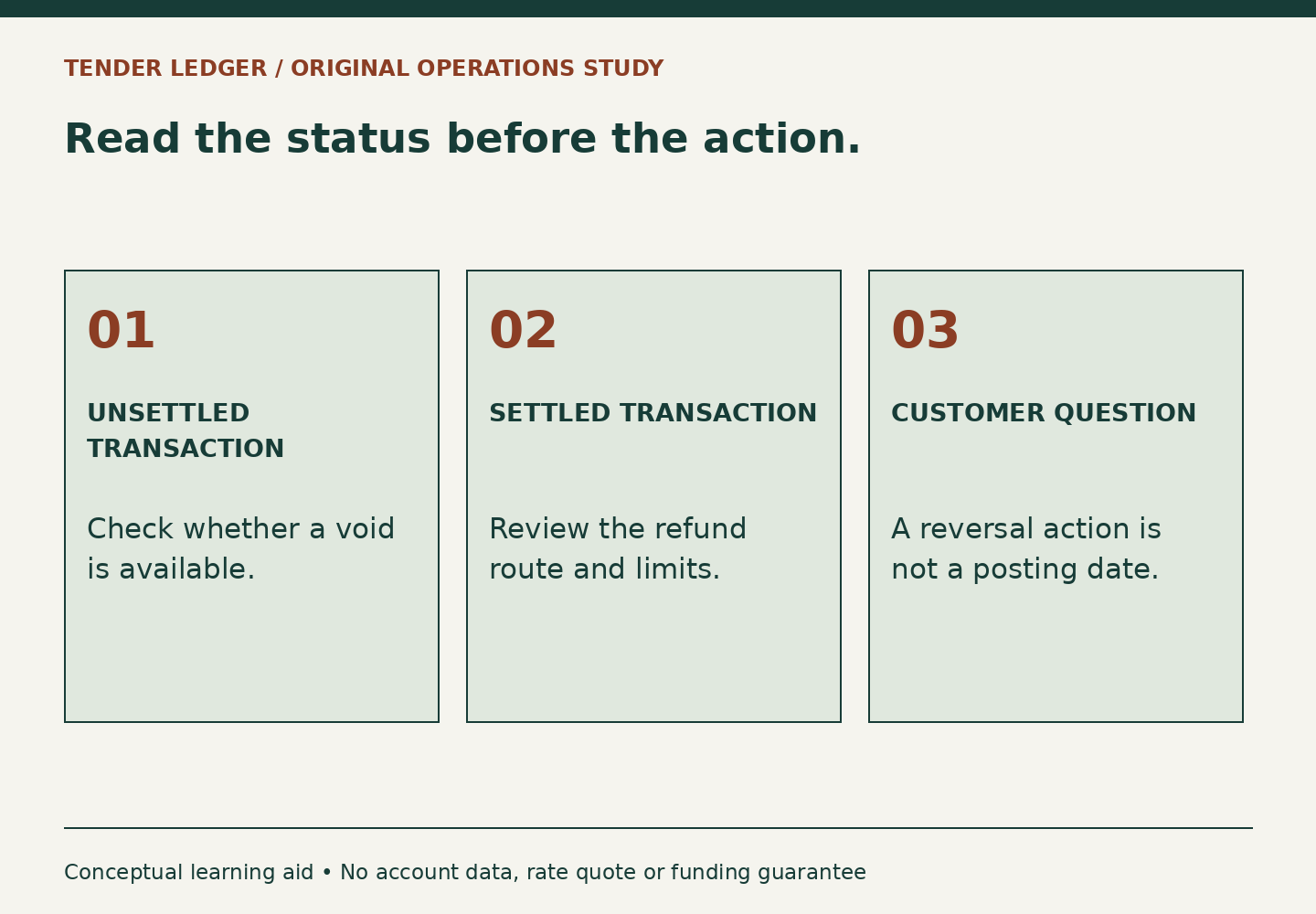
A customer asks to cancel a purchase ten minutes after paying. That sounds like a same-day correction, but the relevant batch may already have closed. Another request arrives earlier in the day for yesterday’s purchase. The time you receive the request is useful context; the original transaction’s state determines which reversal path is available.
Confirm the original before choosing an action
Helcim’s refund and void instructions say a void is available on the processing day before the batch settles; a settled transaction requires a refund instead. Its pricing FAQ says it does not add a refund fee, but the original processing fees remain the merchant’s responsibility. These are distinct facts: no additional refund fee does not mean a completed sale had no processing cost.
Before a reversal, identify the original transaction, its amount, prior reversals and current status. Match the customer’s request to the correct order, especially if several purchases share the same amount. “The most recent $60 payment” is a weak selector when a busy shop sells many $60 items. Use the approved transaction reference in the business system.
Practice the two branches
In an invented example, a cashier accidentally records two $48 sales for one order. The reviewer first confirms that both are actually completed transactions rather than a failed attempt plus a success. If the duplicate meets the current void conditions, the reviewer follows that route for the duplicate only. If it has settled, the refund route becomes relevant. The scenario is a decision exercise, not authorization for anyone to reverse a real payment.
A second fictional customer bought three items for a combined $150 and returns one item worth $45 under the shop’s applicable policy. With a settled credit-card payment, the useful record is a $45 partial refund tied to the original $150 transaction. The remaining unrefunded amount is $105. Refunding the full $150 and creating a new $105 charge would introduce a different payment sequence and should not be invented as a shortcut.
If another employee already refunded $20 on that transaction, the reviewer must account for it before acting. The new request may be for a further $45 or for a total refund of $45 including the prior $20. Those interpretations differ by $20. Ask a precise internal question when the intended cumulative amount is unclear.
Keep three decisions separate
- Eligibility: What return, cancellation or service policy applies to the customer’s request?
- Authority: Which employee may approve and perform the financial action?
- Mechanism: What action is supported by the payment’s present state?
A tool offering a Refund button does not decide the first two questions. Likewise, a manager approving a return does not establish that a void remains technically available. Keeping these decisions separate prevents a common handoff error in which an employee treats a business approval as a complete set of processing instructions.
Verify the resulting record
After an authorized reversal, check its amount, status and relationship to the original transaction. Update the order’s internal history with a concise factual note. A message to the customer should distinguish what the merchant completed from what the customer’s bank has displayed. Do not promise immediate availability of funds unless the relevant service has actually established that timing.
Finish by placing the reversal in the correct reconciliation period. A refund this week for a sale last week is not a reason to erase last week’s original transaction. Preserve the linked history so another reviewer can explain both events. Helcim currently documents full-amount ACH refunds only; the partial credit-card example above does not apply to ACH. For debit cards or unusual cases, follow the current payment-specific instructions and seek processor guidance when the visible state does not support a clear action.