In this guide
A small version-aware record is more useful than a folder of unlabeled screenshots when public career and program pages change.
Give each saved fact an address
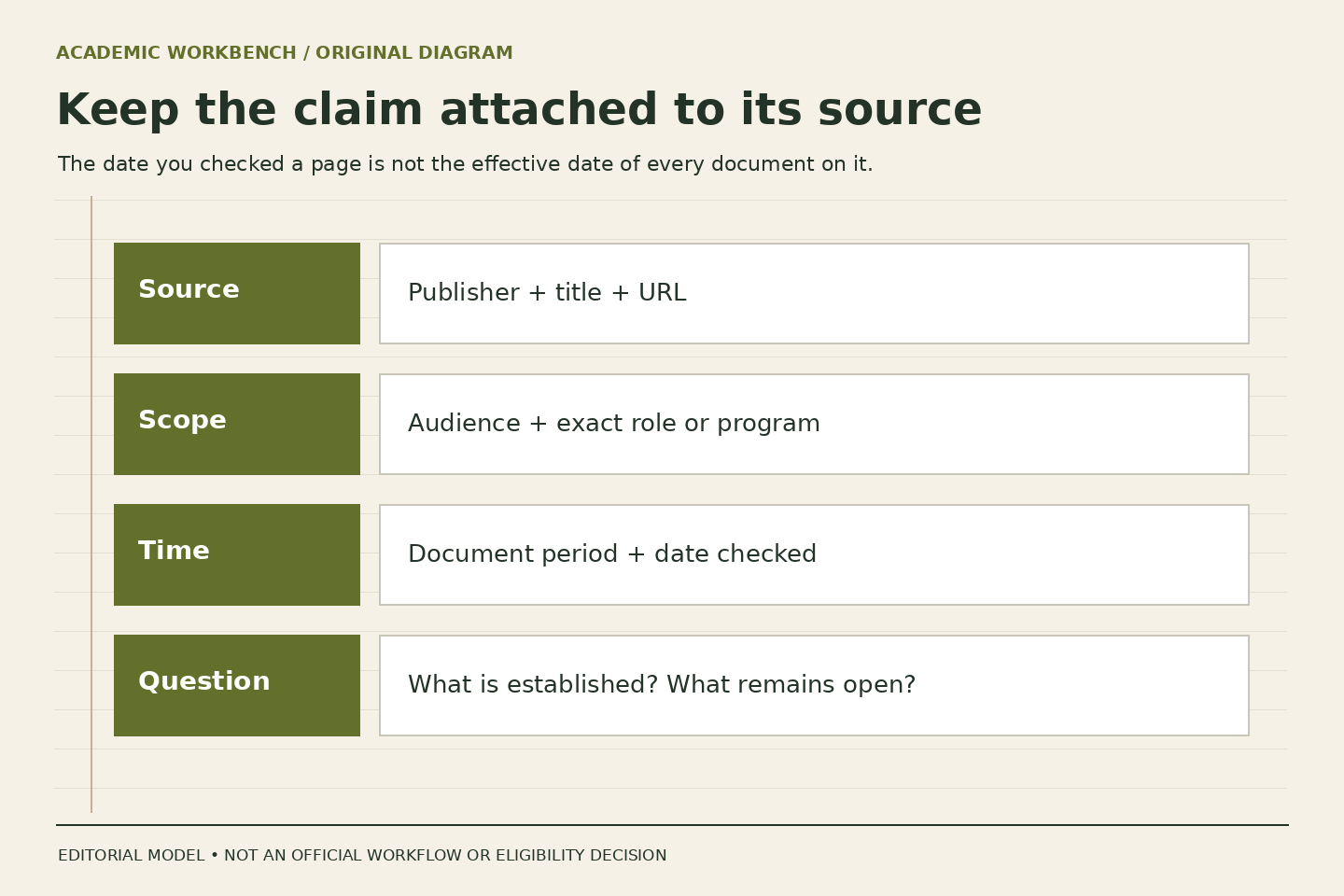
A career-research folder can become surprisingly hard to use. A screenshot loses its context, a PDF has an unhelpful filename and a job title is reused for another recruitment. A source register solves a narrow problem: it records where a claim came from and when you checked it. It does not guarantee that the claim remains current.
Use a few fields: source title, URL, exact role or program, period if stated, date checked and the question the source helps answer. Keep the record small enough to maintain. Copying an entire site creates more material to review without necessarily improving the decision.
Track the change that matters
When revisiting a source, compare the details relevant to your question. A new banner or photograph may not matter; a changed requirement or document year might. Record the change in a short sentence and identify whether it affects your next action. Do not claim a change occurred if you lack the earlier text to compare.
For a hypothetical reader, a vacancy disappears while a career-family page remains. The register can mark the vacancy as no longer confirmed available and retain the family page as background. This preserves useful learning without turning a historical example into an active opportunity.
Use public information only
The UTSW careers, benefits and tuition pages are examples of public sources that answer different questions. A source register for this publication does not need employee records or authenticated screenshots. Keep private correspondence and personal documents in their appropriate protected context rather than combining them with a public research collection.
If you record an official answer for your own use, distinguish it from a published policy and note its scope. Do not generalize a response about your case to every reader. The register should make the limits clearer, not create a new source of unofficial rules.
Set a review trigger
A useful trigger is an event that changes the decision: submitting an application, accepting a confirmed term or planning expenditure. Recheck relevant sources before that event. There is no need to pretend that a register monitors itself or that a once-reviewed page is permanently verified.
The finished artifact can be one page. Its value comes from the relationship between claim, source and question. If you can reopen the right source and explain what remains uncertain, the register is doing its job. More rows are not automatically better research.
Continue reading: Prepare a career question with an object, a source and a consequence, Move from an institution story to a position you can evaluate, Read research application work through service, data and change.