In this guide
Research careers become easier to compare when you identify the output, its next user and the boundary of responsibility.
Start with something another person can use
An academic medical center describes itself through research, education and patient care. Those missions matter, but they are too large to function as job descriptions. Someone considering academic work needs a smaller unit of comparison: a usable output. That might be a checked record, a maintained application, a coordinated meeting, an explained method or a carefully assembled proposal. Asking what another person needs from the role makes the work more visible than asking whether a title sounds scientific enough.
UT Southwestern's research-careers page establishes research as a distinct career area. Its core-facility directory shows that specialized shared resources are also part of the institutional landscape. Neither source says every employee conducts an experiment, authors a paper or holds the same qualification. Our output lens is an editorial way to read that landscape. It is not the institution's classification system, and it should not replace the duties of a particular vacancy.
Make a three-column note headed output, next user and evidence of completion. For an illustrative meeting coordinator, the output might be an accurate agenda with confirmed contributors; its next users are the participants; completion means the required material is available before the discussion. This hypothetical example is deliberately ordinary. Dependable academic work includes making it possible for specialist colleagues to use their time well.
Separate producing, checking and enabling
Two people can contribute to the same project without doing interchangeable work. One produces an analysis, another checks whether the accompanying record is complete, and a third maintains the system through which authorized colleagues receive it. A vacancy may combine these functions, but the combination should be established from its text. Do not assume that working near research makes someone responsible for scientific interpretation.
For each duty, underline the verb and circle the object. Then ask whether the role creates, reviews, coordinates or supports that object. The distinction is especially useful when a posting uses the word support several times. Supporting a research application can mean maintaining a business process, answering user questions, administering permissions under policy or preparing a report. Those are different responsibilities with different evidence requirements.
A candidate who has coordinated complex work outside healthcare can use this analysis without pretending to have laboratory experience. The useful comparison is between mechanisms: organizing contributors, preserving versions, noticing a missing input and making a handoff understandable. The candidate still needs to meet the role's stated requirements. Transferability is a question to substantiate, not a reason to waive a qualification.
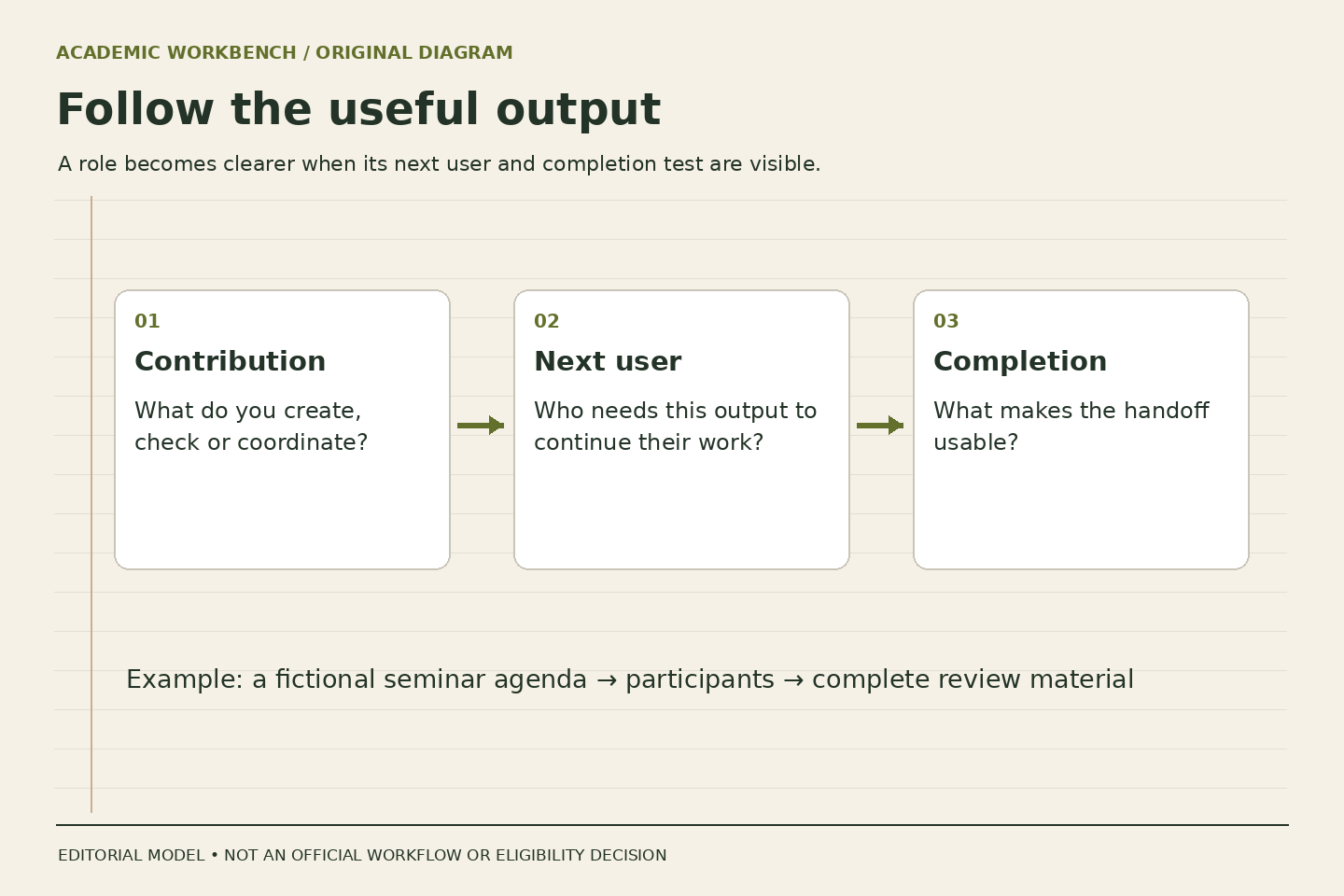
Follow one output across its boundaries
Take a hypothetical seminar. An academic group chooses the scientific content. An administrator may coordinate dates and materials. A technical colleague may support the room or approved platform. A financial colleague may handle an authorized purchasing step. Drawing these as separate contributions reveals questions that a generic statement about teamwork misses: who chooses, who checks, who authorizes and who is informed?
Do not turn this sketch into a claim about an actual UTSW process. The public role descriptions supply examples of the kinds of work involved; your sketch is a preparation exercise. A useful interview question is whether the position is expected to own the complete output or one part of it. Another is which handoffs most often need clarification. Both questions focus on the work instead of asking for confidential organizational detail.
The map also improves how you explain your experience. Say that you assembled material, coordinated review and confirmed distribution if those were your actions. Avoid saying that you directed the program or approved the content unless you truly had that responsibility. Precision makes a modest contribution more credible than an inflated description of the whole team's accomplishment.
Build a shortlist that remains useful
Choose three outputs you would like to spend time producing. Match each with one official career-family page and one actual vacancy when available. Record the exact title and date checked. Beside each match, write a requirement you can demonstrate and a question you cannot answer yet. This leaves you with a shortlist based on work rather than a collection of impressive names.
For example, a person who enjoys keeping complex records consistent might examine research administration, business applications and departmental operations. The common interest does not make the jobs equivalent. One may emphasize sponsor conditions, another system configuration and another coordination among faculty and staff. The output map helps identify those differences before the reader invests time in an application.
Stop the comparison when you reach a missing qualification, an unverified arrangement or an ambiguous authority boundary. The next step is to retrieve the relevant official information or prepare a precise question. This publication does not assess suitability, endorse an employer or predict career outcomes. Its useful result is a clearer description of the work you want to investigate and the evidence that would make the investigation meaningful.
Continue reading: Move from an institution story to a position you can evaluate, A shared research core is a service relationship as well as a facility, Compare responsibility before treating seniority as a ladder.