In this article
Separate wholesale card costs, processor markup and other charges before comparing a quoted number with actual fees.
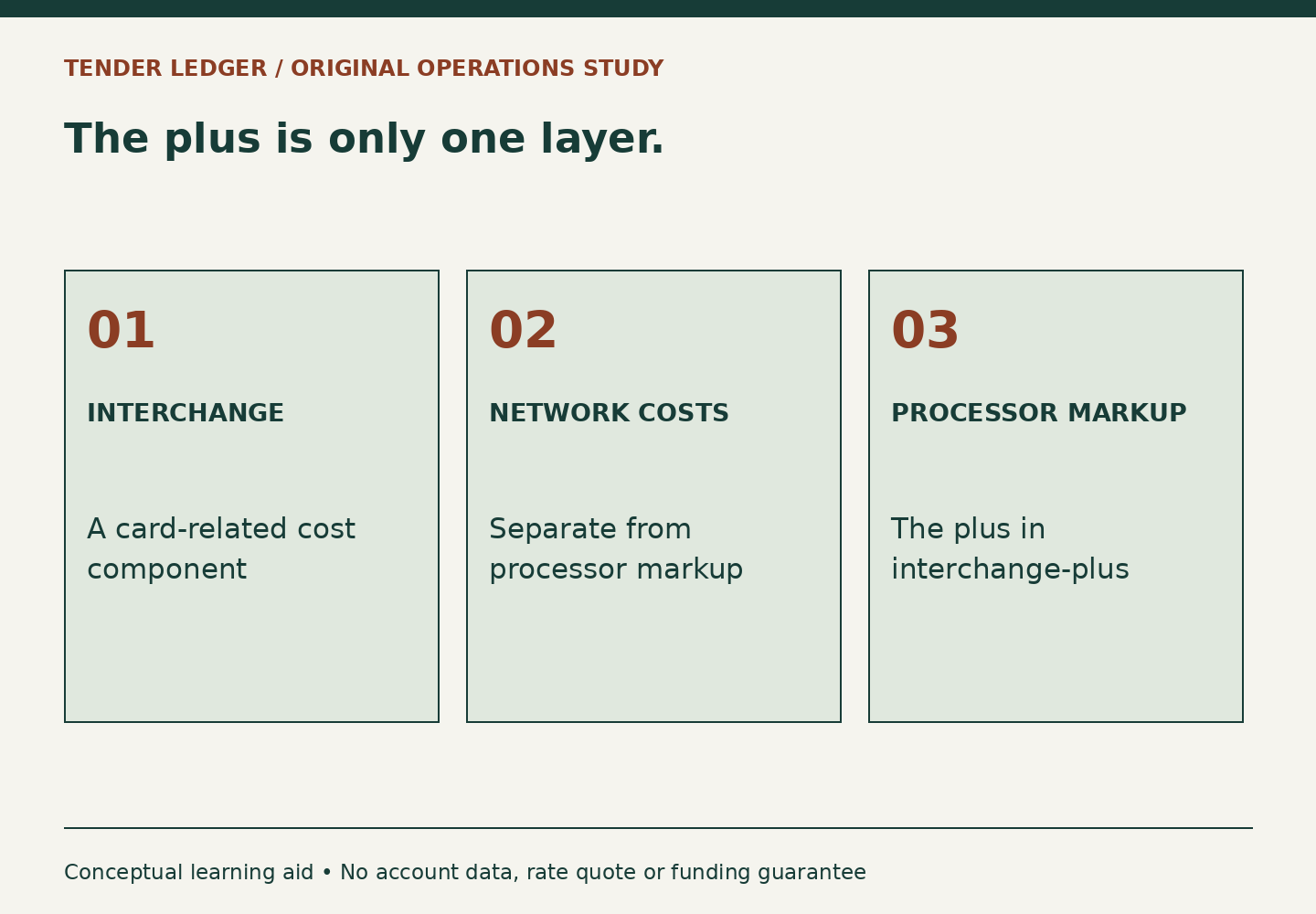
A headline percentage is an incomplete description of an interchange-plus arrangement. It might be the processor’s margin, an example effective rate or a figure based on a selected transaction mix. Those are different measures. A merchant reviewing costs needs to identify what the number includes before deciding whether an actual statement contradicts it.
Label the pieces before doing arithmetic
Helcim describes interchange-plus as underlying interchange and network assessment costs plus its markup. Its public pricing also distinguishes in-person from keyed and online processing. The markup is therefore not the entire processing cost. Check the interchange-plus explanation and the current US pricing page for the relevant channel, tier and terms rather than treating a sample rate as a guarantee. The US fee disclosures provide the accompanying formal fee structure.
For a working review, create separate lines for the pass-through components, the processor’s percentage component, the processor’s per-transaction component and any other documented charge. A line that does not fit is a question to investigate, not a reason to relabel everything “interchange.” Keeping the components visible also helps distinguish a change in customer payment mix from a change in the processor’s margin.
Calculate an intentionally invented transaction
Imagine a fictional $200 transaction with $3.10 of combined wholesale costs. Assume a teaching-only processor margin of 0.35% plus $0.12. The percentage portion is $0.70, and the fixed portion is $0.12, making the invented margin $0.82. Adding $3.10 gives $3.92 total cost. Dividing $3.92 by $200 gives an effective rate of 1.96% for this example.
None of those assumed rates is a current Helcim offer. Their purpose is to show why “0.35% plus $0.12” and “1.96% total” can both describe the same hypothetical payment without being interchangeable. If someone compared only 0.35% with the statement’s 1.96%, they would be comparing a component with a total.
Now imagine another $200 payment has the same invented processor margin but $4.20 of wholesale costs. Its total becomes $5.02. The difference arises entirely from the assumed underlying cost. A reviewer cannot conclude that the margin changed solely because the total did. Conversely, a stable total does not prove every component stayed fixed; opposing changes may cancel out.
Locate the evidence on the statement
Helcim’s monthly-statement guide separates interchange costs, card-brand network costs and Helcim processing costs. Use that structure to ask a narrower question: Which category changed, over what volume, and with what transaction count? Review the statement’s actual channel labels rather than categorizing a payment by where the employee happened to be sitting.
- Identify whether a quoted percentage is margin-only or an all-in example.
- Record the percentage and per-item portions separately.
- Check which payment channel and volume tier the quote describes.
- Keep hardware purchases and unrelated services outside a narrowly defined processing-rate comparison.
- Compare the same period and fee scope before drawing a conclusion.
Write a question that can be answered
“The rate looks too high” leaves the reviewer to reconstruct your calculation. A stronger private support question identifies the statement period, the relevant fee category, the volume and the calculation you expected. Share supporting records only through an approved support route, with unnecessary personal information removed.
The goal is an explained cost, not a predetermined verdict that one pricing model always wins. Ticket size, payment mix, channel and the scope of included services can all change a comparison. This article gives a method for reading the pieces; it does not predict your business’s savings or recommend changing processors based on a fictional example.