In this article
Build a sales-to-bank bridge and distinguish a net deposit from a gross deposit with a separate fee withdrawal.
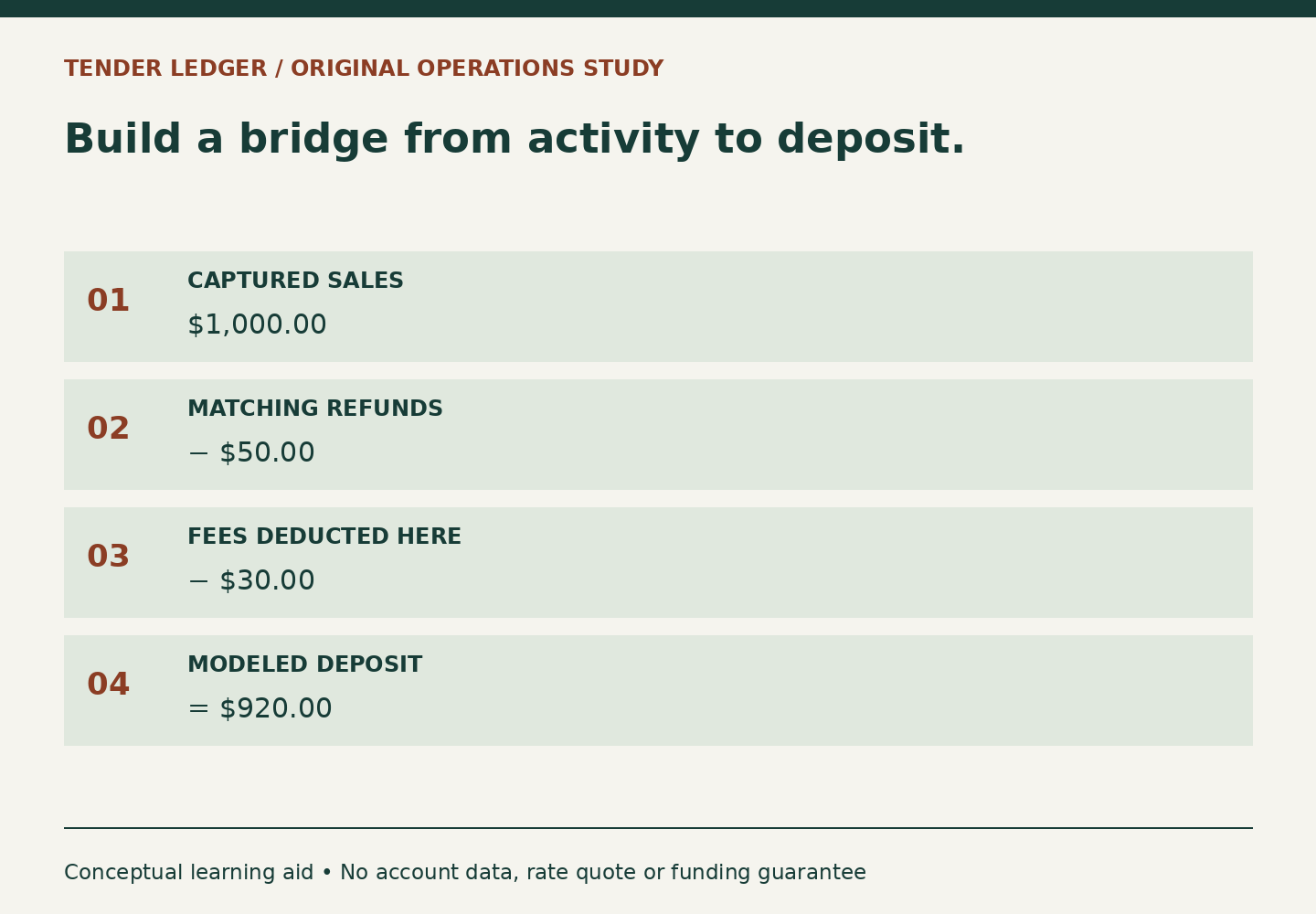
A deposit smaller than sales may be exactly right. A deposit equal to sales may still have an associated fee withdrawal. The first reconciliation question is therefore not “What percentage is missing?” It is “How does this account present the movement of money?” Start with the deposit method and the associated records before calculating a difference.
Separate economic result from bank presentation
Helcim offers gross deposits, with processing fees withdrawn separately, and net deposits, with fees deducted before deposit. Its gross and net deposit guide says merchants start on gross deposits and can request a change through support. Treat that as product documentation, not evidence of your current setting. Helcim’s deposit-monitoring guide describes the deposit and batch records available for investigation.
In both presentations, the business needs to understand sales, reversals and fees. What changes is the arrangement of bank entries. A clean worksheet has one section for processor activity and another for bank movements, joined by verified references. It does not treat the bank statement as a substitute for the underlying sales record.
Use a small, fully specified bridge
Assume a fictional batch has $2,400 in captured sales, $120 in refunds, no other adjustments and $56 in processing fees. These amounts are invented for arithmetic and are not a Helcim rate quote. Sales less refunds equal $2,280. After fees, the batch contributes $2,224. The two answers represent different levels of the same bridge.
Under a simplified net presentation, look for $2,224 coming in. Under a simplified gross presentation, look for $2,280 coming in and $56 going out separately. Both produce a $2,224 combined bank movement. A reviewer who subtracts $56 again from the net deposit records only $2,168 and creates a false discrepancy. A reviewer who ignores the gross-method withdrawal overstates the combined movement by $56.
Real activity may also include chargebacks, ACH returns, adjustments or more than one bank posting. Do not silently add those possibilities as balancing plugs. An adjustment belongs in the bridge only when a record identifies it and its direction. Mark an unknown difference as unknown until you find evidence.
Use the sketch as a reasoning check
The Settlement Balance Sketch lets you practice the arithmetic using invented amounts. Its role is to make the bridge visible. A zero difference establishes arithmetic agreement only, not that the records are complete or correct. It cannot inspect your account, identify a deposit or verify that a payment settled. Do not enter bank details, customer identifiers or transaction records. Use synthetic numbers like the example above.
- Match the relevant batch or deposit reference, rather than relying only on a similar amount.
- Confirm whether fees are already included in the net figure you selected.
- Explain every reversal and adjustment from a separate record.
- Check timing when an associated withdrawal posts on a different date.
- Record unresolved items instead of changing a number to make the total agree.
Test the result from both directions
First work forward from processor records to expected bank movements. Then work backward from the bank entries to the records they represent. If the backward pass assigns one deposit to two batches without evidence, or one fee withdrawal to two periods, the bridge is not finished. Equal totals alone can hide duplicate and omitted items that happen to cancel each other.
A useful completion note for the invented example is: “Batch B-208 reconciles to a $2,280 deposit and separate $56 fee withdrawal; combined movement is $2,224.” It states the presentation and result without calling bank inflow revenue or prescribing accounting entries. Your accountant can determine the appropriate ledger treatment using your actual records and reporting requirements.