In this article
Distinguish authorization, batch submission and bank posting, and use business-day ranges without promising an arrival date.
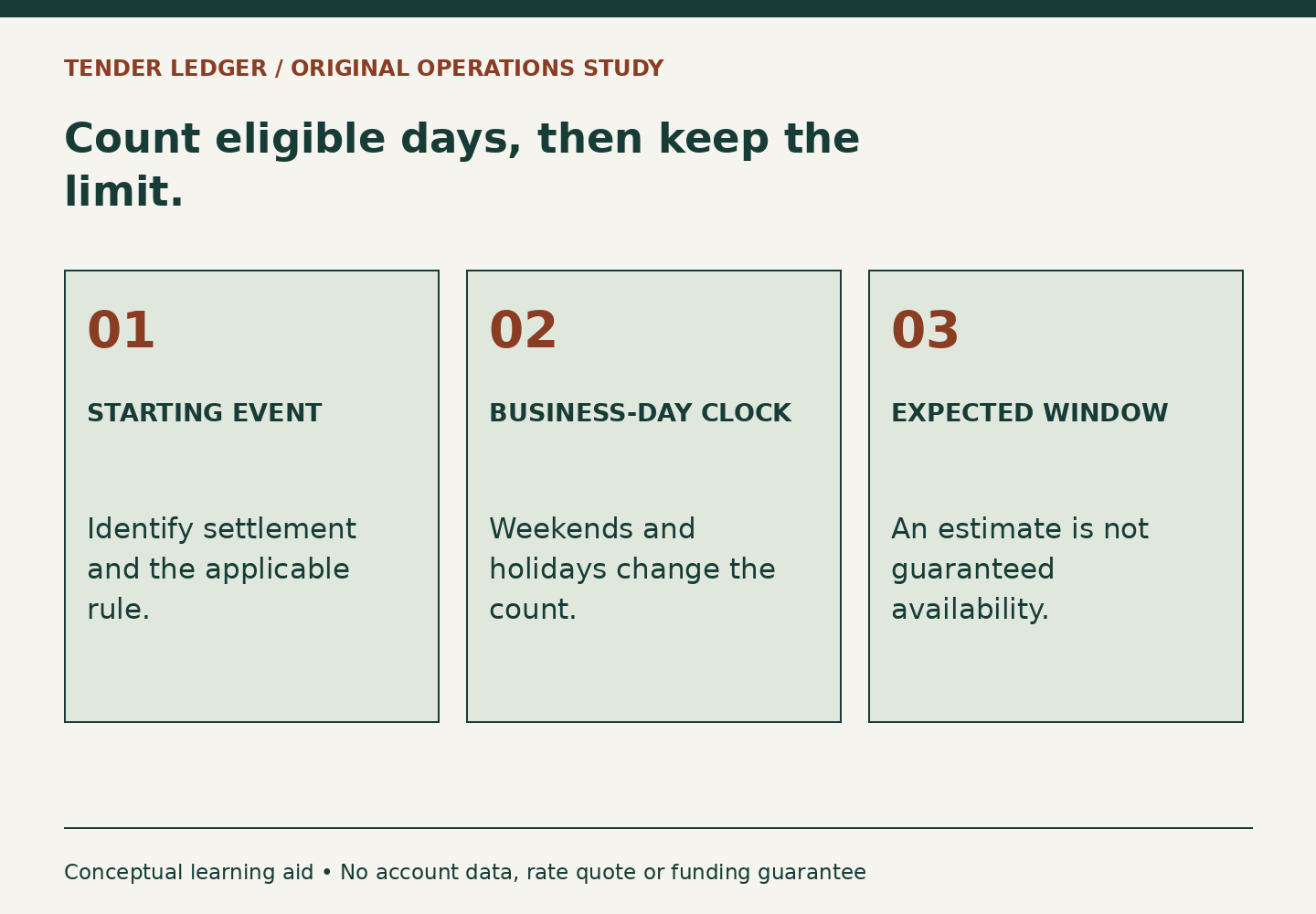
An ACH payment initiated on Friday is not necessarily a Friday-funded payment. It may still await customer authorization, miss a submission cutoff or sit in a less frequent batch. Then the banking timeline begins. The most useful question is “Which event has actually happened?” rather than “How many calendar days since someone clicked Pay?”
Read the newer timing guidance carefully
As checked October 9, 2026, Helcim’s funding guide, updated June 5, 2026 says ACH deposits typically take three to five business days after settlement and may take longer for initial batches or reviews. Older ACH batch guidance says three to four business days. These public descriptions differ. Use the newer funding range as general planning context and confirm account-specific expectations with Helcim; neither range guarantees an individual deposit date.
The ACH batch guide also distinguishes batch frequency from the network-processing period. Waiting for a weekly close is extra time before processing, not a faster version of the same journey. Helcim’s ACH status guide distinguishes a pending payment, a processed payment, a network-settled payment and a return. The associated batch has its own state. One label cannot answer every funding question.
Build a fictional calendar with an explicit assumption
Suppose a training example has a batch submitted on Friday and no bank holidays. For simple counting, assume the next business day is day one. Monday is one, Tuesday two, Wednesday three, Thursday four and Friday five. That exercise makes the difference between calendar days and business days visible. It is not a prediction that a real Friday payment will post on a particular day.
Now imagine the payment was approved on Monday but the fictional merchant chose a weekly Friday batch close. There is a wait before Friday’s submission, followed by the processing window. Counting from Monday as though network processing started immediately understates the possible elapsed time. The same reasoning applies when an approval occurs after the relevant cutoff and joins a later batch.
Add a bank holiday to the exercise and the business-day count shifts again. Do not solve that change by simply adding a fixed number of calendar days to the payment date. Record the actual event, the relevant calendar and the assumption used for the estimate. A planning worksheet should make those dependencies obvious to anyone who reads it later.
Use a four-question funding check
- Has the customer completed the required payment authorization?
- Which batch contains the approved transaction, and when did that batch close?
- Is there a review, return or other status that changes the normal expectation?
- Does the deposit record show a movement that the bank has posted?
If the first answer is unknown, debating day three versus day five is premature. If the batch is identified but the deposit remains unmatched, preserve that distinction. A precise internal update can say, “Authorization is complete and the payment appears in the Friday batch; the bank entry has not yet been matched.” It communicates progress without inventing certainty.
Keep fulfillment decisions separate
A business may need its own approved policy for when to release goods or begin service. A public average funding range does not settle that policy and does not eliminate return risk. This publication does not decide what exposure your business should accept. Use the verified payment state, your established procedures and qualified advice where necessary.
When asking for help with a delayed deposit, supply the batch reference, submission time, current status and the relevant bank observation through an approved support channel. That gives the support team an event sequence to investigate. Repeating the original debit to see whether it moves faster can create a second obligation; it is not a way to diagnose the first payment.